
OBJECTIVE OF CONDUCTING THE CFD ANALYSIS
The client is a global medical device OEM, one of the fastest growing in this segment. The client has approached us with the existing design of the high-voltage X-ray tank unit. The client is interested in understanding the heat transfer phenomena for the complete system, which enables him to make conscious engineering decisions to enhance the performance of the device. Our CFD model is validated with the experimental results. CFD model is finetuned in all possible aspects, and we ensured that it represents the actual physical phenomena. All the heat transfer paths are analyzed, and the heat balance sheet has enabled our client to take well-informed engineering designs.

CFD ANALYSIS APPROACH
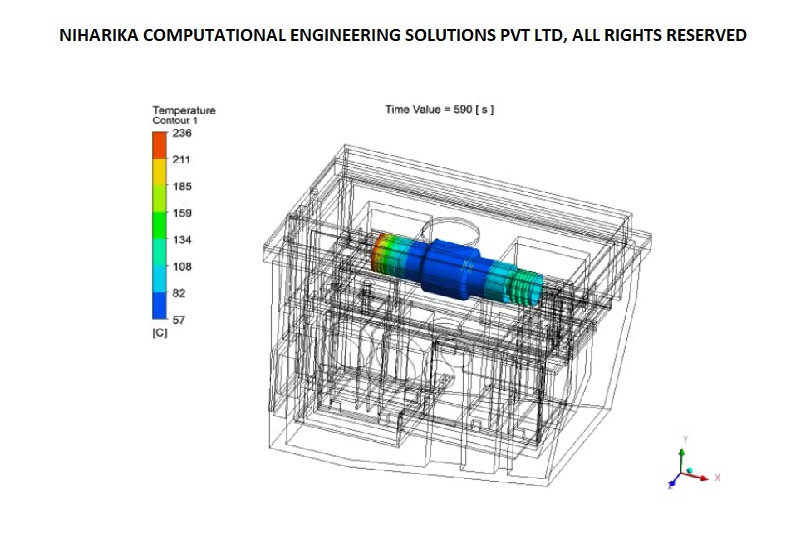
The computational domain is discretized using a poly-hexcore mesh comprising approximately 3 million cells to achieve a balance between computational efficiency and solution accuracy. The transformer units and PCB assembly are represented as equivalent thermal blocks with appropriate material properties and heat generation rates. The X-ray tube is modelled in greater detail, including key components such as the cathode, anode, filament, and focal point, with suitable material properties and thermal boundary conditions to accurately represent heat generation and dissipation. A transient CFD analysis is performed over a total duration of 16 minutes to capture the time-dependent thermal behaviour of the system. The transformer oil is modelled by accounting for buoyancy-driven natural convection, enabling the prediction of fluid circulation and heat transfer within the tank. Intermediate CFD results are evaluated at different time intervals to track temperature evolution, identify potential hot spots, and understand the transient heat transfer characteristics of the high-voltage X-ray tank assembly.
CFD ANALYSIS RESULTS
The CFD simulation achieved smooth and stable convergence, demonstrating the suitability of the mesh quality and time step settings adopted for the transient analysis. Post processing focused on evaluating the thermal behaviour of the system through temperature distribution, temperature variation over time, and heat flux across critical components and interfaces. The intermediate simulation results were analysed to understand the evolution of heat transfer, identify potential hot spots, and assess the overall thermal performance of the high voltage X ray tank assembly. The final deliverables included a comprehensive CFD analysis report documenting the simulation methodology, boundary conditions, and key thermal findings, along with transient animation videos illustrating the thermal behaviour of the complete system at multiple time intervals, as specified by the customer.
We Got More
Go through All Our Case Studies

CFD analysis of closed-loop anesthesia delivery system (CLADS)
Closed loop anesthesia delivery systems are specifically engineered to automate and enhance the administration of anesthesia throughout surgical procedures. By constantly monitoring crucial indicators like oxygen levels and breathing patterns, these systems intelligently adapt the anesthesia dosage to ensure the patient receives the precise amount required at any given moment. This not only enhances the overall efficiency of the procedure but also significantly improves its safety. Read More
Computational fluid dynamics analysis of neonatal body temperature controller unit
The Neonatal body temperature controller, an initiative by the Government of India, aims to protect newborn babies from Hypoxic ischemic encephalopathy. Our client is working with the Government of India and the Government of Karnataka state to develop this technology for usage in Primary Health care Centers in rural and remote areas. Read More
CFD analysis for General Electric data center,Bihar,India
Computational Fluid Dynamics (CFD) analysis is extensively used in data center projects to study the flow development and temperature field and identify the thermal hot spots in the projects design stage. CFD analysis results enable the thermal designer to make well-informed decisions in the design stage and eliminate all the uncertainties that may affect the electronic equipment mounted in the racks. We carried out CFD analysis for the large data center under construction in the Bihar state of India by Shapoorji and Pallonji EPC company, one of the largest EPC Companies in India. Our CFD analysis results have enabled our customers to optimize the air-cooling system and ultimately to realize an efficient, safer, and effective data center cooling mechanism. Read More
CFD analysis of Modular Data Center
Prefabricated modular data centers, often referred to as integrated modular solutions or containerized data centers, are designed to cater to specific business needs, providing a tailored and secure infrastructure that differs from conventional brick-and-mortar designs. Read More
CFD analysis of Hybrid Cooled Data Center
Advanced AI and machine learning workloads are causing powerful GPUs to produce unprecedented heat levels in conventional server settings. Hybrid cooling solutions enable data center operators to manage these elevated temperatures without the need for complete retrofitting of current facilities, facilitating a gradual and cost-efficient method for incorporating liquid cooling tailored to specific high-heat applications. Read More