Scope of Work – Structural Validation of a 32 kL Crude Oil Storage Tank
The scope of this project was to validate the structural integrity and design adequacy of a 32-kilolitre (32,000-litre) crude oil storage tank, including its cone roof, intended for installation at the Adani Petrochemical plant. The primary objective was to ensure that the tank and roof structure could withstand the specified operating and loading conditions while satisfying the applicable structural design requirements. Our customer engaged us to perform a comprehensive structural assessment using the Finite Element Analysis (FEA) approach. The analysis involved developing a suitable finite element model of the tank and cone roof, defining the relevant material properties, boundary conditions, and loading scenarios, and evaluating the resulting structural response. Particular attention was given to stress distribution, deformation, and critical structural connections to identify potential areas of concern and verify the adequacy of the proposed design. During the assessment, we worked closely with the customer's engineering and design teams to review the analysis results, resolve minor design uncertainties, and evaluate necessary modifications. Where potential concerns were identified, we supported the customer in refining the design and reassessing its structural performance through successive analysis iterations. This collaborative, analysis-driven approach helped ensure that the final configuration was both structurally adequate and suitable for the intended application. Upon completion of the assessment and review of the revised design, we concluded that the tank and cone roof satisfied the evaluated structural acceptance criteria under the specified loading conditions. The analysis provided the customer with greater confidence in the design's structural integrity and supported the progression of the project toward fabrication.

Case 1: Empty Tank Without Applied Pressure
The first analysis was conducted with the tank in an empty condition and without any applied internal or external pressure. This case was used to assess the baseline structural response of the tank and cone roof, considering the modeled structural loads and boundary conditions. The analysis helped establish the stress distribution and deformation characteristics of the structure in the absence of pressure loading.
Case 2: Tank Filled to a Height of 19.2 m
The second analysis considered the tank filled to a liquid height of 19.2 m, with a specified pressure of 320 mm water column. This loading condition was used to evaluate the structural response of the tank shell, bottom, roof-supporting structure, and associated connections under the prescribed loading. The resulting stress distribution and deformation were assessed to identify potential critical regions and verify the structural adequacy of the design under the specified filled-tank condition.
Case 3: Empty Tank Under External Pressure
The third analysis was performed with the tank empty and subjected to an external pressure of 50 mm water column. This case was intended to assess the structural response of the tank under external pressure loading, with particular attention to the stability of the tank shell and cone roof. The analysis helped evaluate the potential for excessive deformation and pressure-induced structural instability under the specified conditions.
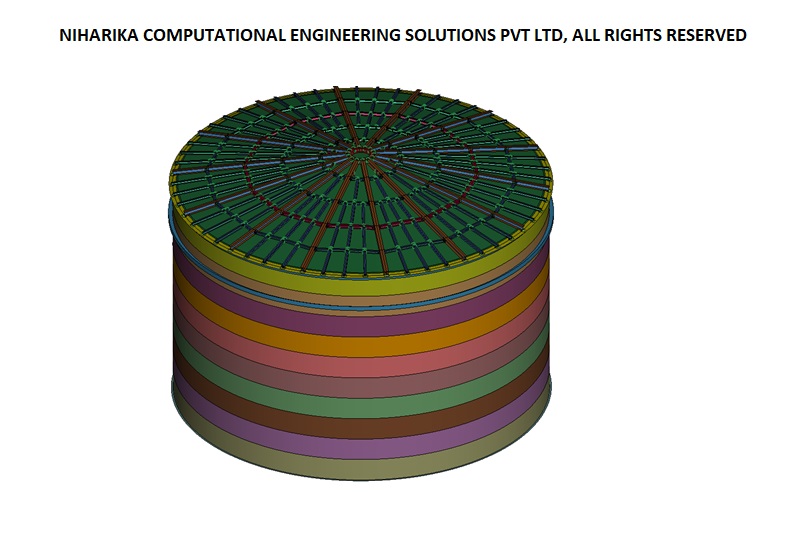
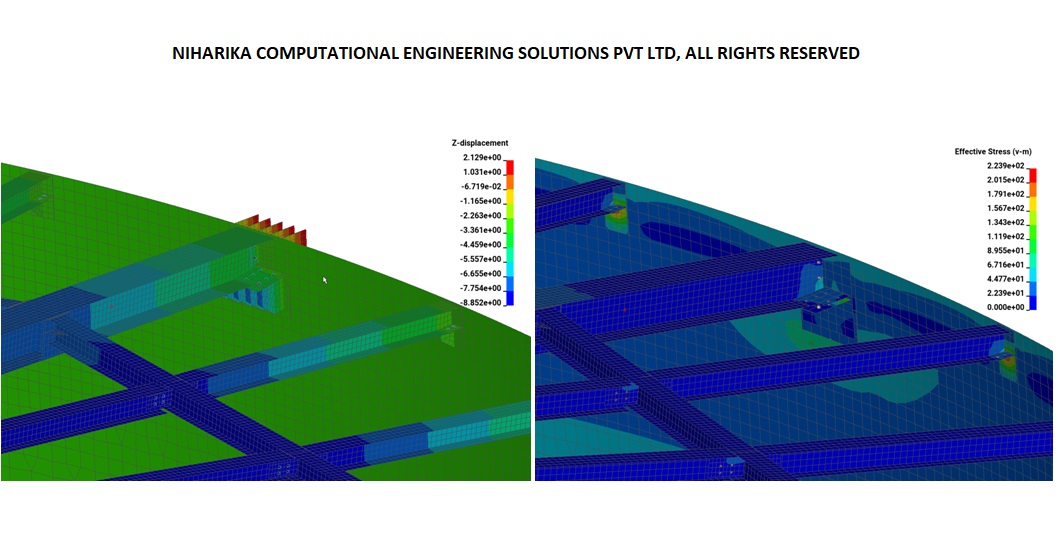
The initial Finite Element Method (FEM) analysis of the existing tank design revealed that the connection between the main roof rafter and the tank sidewall required strengthening to ensure adequate structural performance. The analysis helped identify this critical area by evaluating the stress distribution and structural response under the specified loading conditions. To address this concern, the NCES team collaborated closely with the client's design team to review the analysis findings and determine suitable design improvements. Minor modifications were incorporated into the existing design, with particular attention given to enhancing the strength and structural integrity of the main rafter-to-sidewall connection. Following these modifications, a revised FEM analysis was performed to evaluate the updated design under the relevant loading conditions. The results were reviewed to assess the effectiveness of the modifications, verify the structural response of the critical connection, and confirm that the revised configuration satisfied the required structural acceptance criteria.
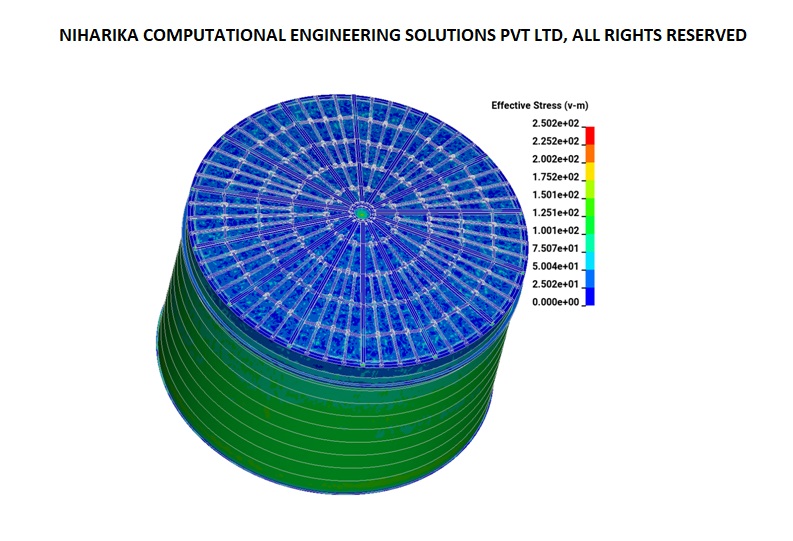
Following the initial analysis, three iterations of design modifications were evaluated using Finite Element Method (FEM) analysis to improve the structural performance of the tank and its cone roof. Each iteration was assessed under the specified loading conditions to examine the stress distribution, deformation, and overall structural response, with particular attention given to the main rafter-to-sidewall connection identified in the initial assessment. The analysis results from each iteration were reviewed to evaluate the effectiveness of the proposed modifications and determine whether the revised design met the required structural acceptance criteria. Through this iterative process, the design was progressively refined, addressing the identified concerns and improving confidence in the structural integrity of the tank assembly. The final design iteration demonstrated satisfactory structural performance under the evaluated loading conditions, providing sufficient confidence to proceed with fabrication. In addition, the revised design underwent an independent review and received approval from a third-party reviewer. This approval further supported the validation process and enabled the project to proceed to the fabrication stage.
We Got More
Go through All Our Case Studies
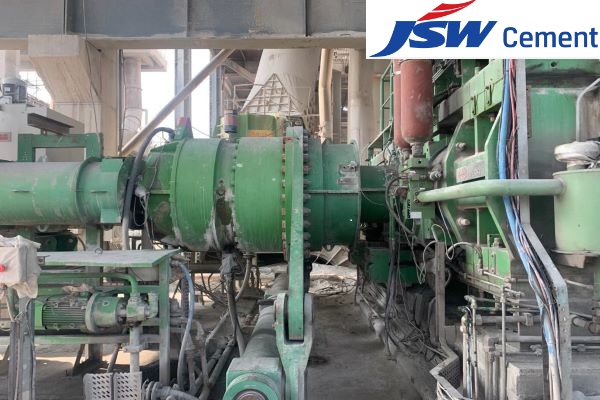
Cement grinding plant Roller shaft re-design and FEM analysis
Frequent failure of the shaft used in cement grinding units at our customers plants across India warranted an independent review of the shaft design. Niharika Computational Engineering Solutions Pvt. Ltd. (NCES) was chosen for this Independent review task using the finite element method. NCES was provided with information on the working principles of the roll press system and also information on the material used for the shaft that is in question, along with detailed drawings. To better understand the design of the shaft for various loads that it would see during normal operation, a comprehensive study was undertaken by the NCES team. This study involved using Finite Element Analysis (FEA) and performing static analysis for load distribution, modal analysis for estimating natural frequencies, rotor dynamics for checking resonance due to vibration, and dynamic analysis to estimate endurance limit under complex loading and crack initiation and propagation. NCES team has modified the shaft design and recommended a new material that addresses the frequent failure of the shaft. Read More
CFD analysis of Wind turbine Generator unit
This project is executed for Siemens Gamesa Renewable Energy. The objective is to conduct CFD analysis for the Wind Turbine generator (WTG) unit at the assembly level and to estimate the temperature developed on all the subsystems We carried out CFD analysis for two configurations, a) The existing configuration consists of four exhaust fans on top of the WTG system and converter refrigerant cooling fan capacity is 1.5 KW. b) The proposed configuration with three exhaust fans at the top of the WTG system and converter refrigerant cooling fan capacity is enhanced to 2.6 KW All the major subsystems in the WTG unit, like transformers, Generator & slip ring system, converter panel, gearbox unit, hydraulic oil tank and converter coolant (refrigerant) systems are considered in the CFD analysis. Read More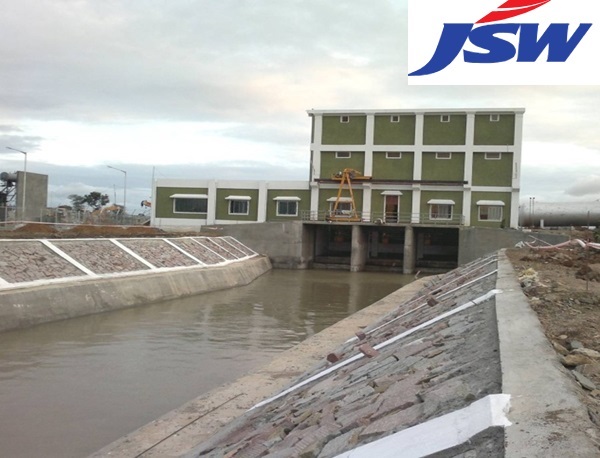
Diagnostic study to eliminate resonant vibrations in vertical Turbine Pumps at JSW-Almatti Pumping station
After the implementation of the solution engineered by the NCES team, all the pumps have been operating without any vibration issues for six months. This is similar to the condition ten years ago when Larsen and Toubro Limited handed over the pumping station to JSW Limited. Read More
CFD analysis of Multi Band Remote Radio Unit
The advent of 5G technology has brought about unprecedented advancements in wireless communications, enabling faster speeds, lower latency, and increased capacity. These advancements are associated with higher power consumption and increased heat generation in the 5G Remote Radio units.Increasing data rates and network densification require radio units to process larger volumes of data, leading to higher power consumption and heat generation. Environmental factors such as ambient temperature, humidity, and exposure to direct sunlight also impact the thermal aspects of the radio units. Read More