Scope of work - Ruggedized EMC Rack
The project involves a comprehensive finite element analysis (FEA) of a data center server rack equipped with shock isolators to evaluate its vibration and shock response under operational and external dynamic loading conditions. The primary objective is to assess the effectiveness of the isolation system in reducing vibration transmission to sensitive IT equipment while maintaining the structural integrity and stability of the rack. A three-dimensional finite element model of the server rack, mounted servers, support structure, and shock isolators will be developed. Modal analysis will be performed to determine the natural frequencies and mode shapes of the assembled system. Harmonic response analysis will be conducted to evaluate vibration transmission, displacement, acceleration, and dynamic stresses under excitation from cooling fans, rotating machinery, and other relevant sources. Transient dynamic analysis will be performed, where required, to assess the response of the server rack to shock loads caused by equipment handling, transportation, floor impacts, or other specified shock events. The shock isolators will be modelled using appropriate stiffness, damping, and load-deflection characteristics to evaluate their influence on the system's dynamic response.

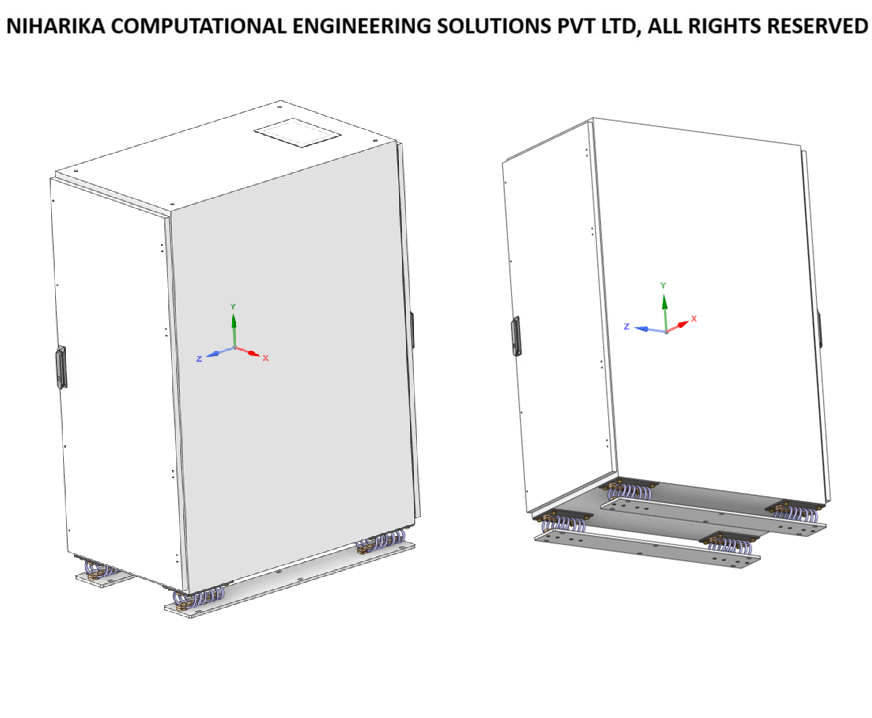
Description of the CAD Model considered for Vibration Analysis
A detailed three-dimensional finite element model of the data center server rack was developed, incorporating the rack frame, mounted servers, supporting structure, mounting interfaces, and shock isolators. The model represented the structural configuration, material properties, mass distribution, and relevant connection conditions to capture the overall dynamic behaviour of the assembled system. Appropriate element types, mesh refinement, and boundary conditions were defined to ensure reliable simulation of the structural response under vibration and shock loading. The developed model was used for modal, harmonic response, and shock analyses to evaluate structural integrity, identify potential resonance issues, and assess the effectiveness of the shock isolators in mitigating vibration transmission.
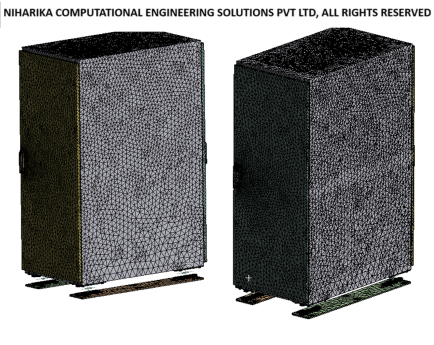
FEA Mesh for Vibration Analysis
Server Rack was discretized using a combination of higher-order tetrahedral and hexahedral finite elements to accurately represent the complex geometry of the rack and its structural components. The finite element (FE) model consists of 2800672 nodes and 1738322 elements, providing a detailed representation of the assembly for subsequent structural and dynamic analyses. Higher-order elements, which incorporate additional nodes along their edges, enable improved representation of curved surfaces and complex deformation patterns compared with linear elements, particularly when the mesh quality is appropriate. Tetrahedral elements were used to accommodate geometrically complex regions, while hexahedral elements were employed in suitable regions of the model. Furthermore, appropriate contact definitions were established between the individual components to represent their interfaces and facilitate load transfer throughout the assembly. These contact interactions help capture the structural behavior of the server rack under applied loading conditions and provide a reliable foundation for subsequent finite element analyses, including modal, shock, and Harmonic studies.
Modal Analysis - EMC Rack
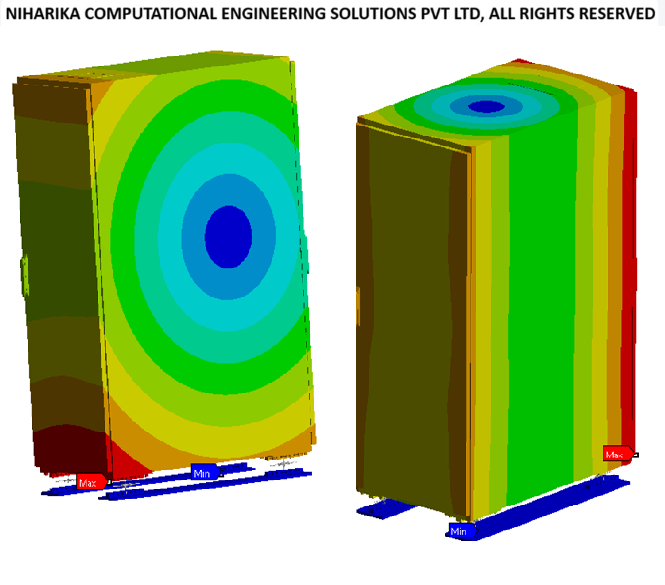
The natural frequencies and corresponding mode shapes of the assembled server rack system were identified through modal analysis, with the shock isolators incorporated into the finite element model. The dynamic stiffness of the isolators was considered where relevant to accurately represent their influence on the system’s overall stiffness and dynamic characteristics. The analysis evaluated the dominant vibration modes of the rack structure and mounted servers, helping identify potential resonance conditions and assess the impact of the isolators on the system’s natural frequencies. These results provided a basis for evaluating structural dynamic behaviour and identifying critical modes that could be excited by operational or external vibration sources.
Harmonic response analysis
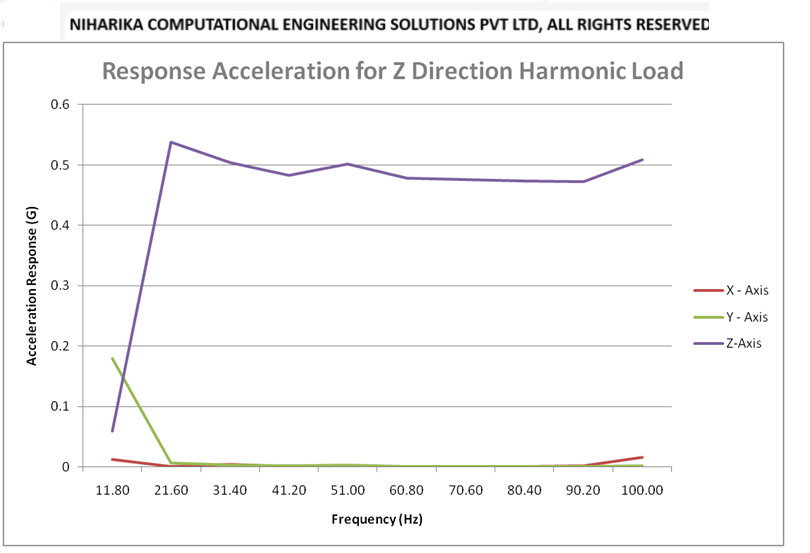
Harmonic response analysis evaluates the steady-state vibration behaviour of a server rack subjected to sinusoidal excitation over a specified frequency range. The analysis determined whether the shock isolators effectively reduced vibration transmission and protected sensitive server equipment. Identified critical excitation frequencies where the rack exhibits peak vibration response or resonance. Evaluated vibration acceleration at server mounting locations to assess the potential impact on sensitive IT equipment. Identified critical stress concentrations in the rack frame, mounting brackets, fasteners, and support connections. Recommended suitable isolator properties and structural modifications to minimize vibration while maintaining rack stability.
Shock response analysis
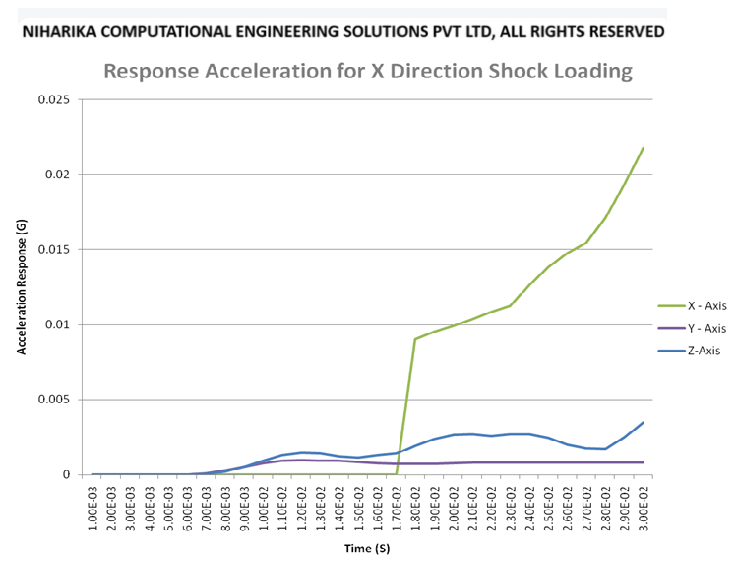
The transient shock analysis evaluated the structural response of a data center server rack equipped with shock isolators under sudden impact or shock loading. The study assessed peak acceleration, deformation, stress distribution, and isolator performance to determine whether the rack and its installed IT equipment can withstand the specified shock event.
Conclusion of Vibration Analysis
The harmonic analysis provides a quantitative assessment of the server rack's dynamic response and the effectiveness of the shock isolation system. Comparing results with and without isolators helps establish the reduction in transmitted vibration, identify critical operating frequencies, and guide isolator selection and structural optimization. The final design should satisfy the specified limits for server acceleration, rack displacement, structural stress, and isolator travel. Actual vibration reduction percentages and peak response values must be determined from simulation results rather than assumed in advance.
We Got More
Go through All Our Case Studies

CFD analysis for General Electric data center,Bihar,India
Computational Fluid Dynamics (CFD) analysis is extensively used in data center projects to study the flow development and temperature field and identify the thermal hot spots in the projects design stage. CFD analysis results enable the thermal designer to make well-informed decisions in the design stage and eliminate all the uncertainties that may affect the electronic equipment mounted in the racks. We carried out CFD analysis for the large data center under construction in the Bihar state of India by Shapoorji and Pallonji EPC company, one of the largest EPC Companies in India. Our CFD analysis results have enabled our customers to optimize the air-cooling system and ultimately to realize an efficient, safer, and effective data center cooling mechanism. Read More
CFD analysis of Modular Data Center
Prefabricated modular data centers, often referred to as integrated modular solutions or containerized data centers, are designed to cater to specific business needs, providing a tailored and secure infrastructure that differs from conventional brick-and-mortar designs. Read More
CFD analysis of Hybrid Cooled Data Center
Advanced AI and machine learning workloads are causing powerful GPUs to produce unprecedented heat levels in conventional server settings. Hybrid cooling solutions enable data center operators to manage these elevated temperatures without the need for complete retrofitting of current facilities, facilitating a gradual and cost-efficient method for incorporating liquid cooling tailored to specific high-heat applications. Read More
CFD analysis of Multi Band Remote Radio Unit
The advent of 5G technology has brought about unprecedented advancements in wireless communications, enabling faster speeds, lower latency, and increased capacity. These advancements are associated with higher power consumption and increased heat generation in the 5G Remote Radio units.Increasing data rates and network densification require radio units to process larger volumes of data, leading to higher power consumption and heat generation. Environmental factors such as ambient temperature, humidity, and exposure to direct sunlight also impact the thermal aspects of the radio units. Read More